
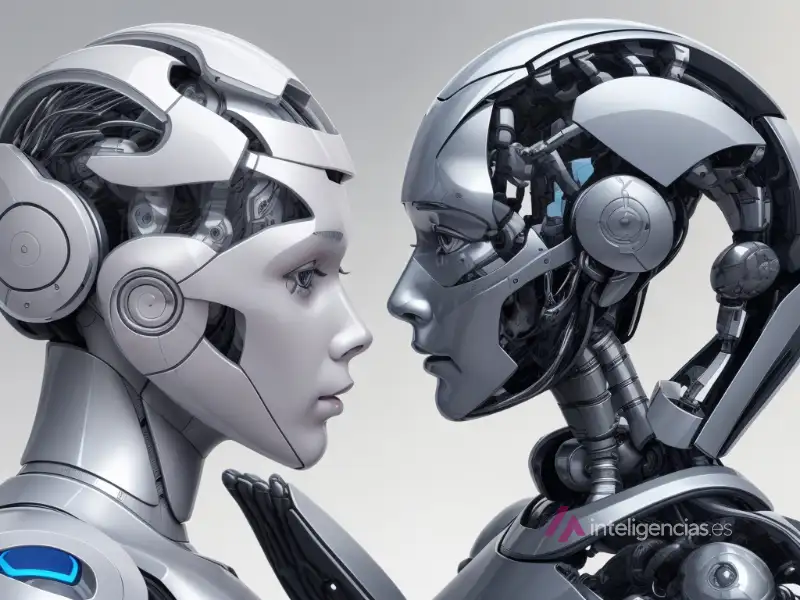
Advances in robotics and AI are dizzying. There are already highly advanced humanoid robots that can walk, talk and even show emotions. Some think that soon it will be difficult to distinguish between a robot and a human.
For now, however, robots don’t feel anything. They don’t find a sunset beautiful, they don’t rejoice if you praise them. But we humans tend to anthropomorphize machines, we name them, we treat them like pets.
Robotic avatars: our second selves
In Italy they developed one of the most advanced humanoid robots. It allows to have an extra bodily experience: the human controls it with his movements and the robot gives him back all his sensations.
It is like having a second robotic self. We could travel anywhere with our avatar, even into space. This would help people with disabilities to work remotely.
We are still in the beginning, it’s like the first automobiles. But in 20 to 30 years we will have androids almost indistinguishable from humans. This raises ethical questions about our relationship with them.
Virtual doubles: digital immortality?
It is also possible to create hyper-realistic virtual doubles of a person by analyzing their gestures and voice. You could interact with your digital twin to access your knowledge.
Even after you die, your virtual double could appear in movies or answer questions. It’s an unsettling idea. High-quality data to copy a person’s essence is still lacking.
For now it’s easy to distinguish between humans and digital avatars. But in 200 years people will look back and smile at how primitive our technology was.
Robots in our daily lives
Robots are already pervasive in our daily lives: vacuum cleaners, lawn mowers, voice assistants. At first they seem novel, then we get used to them

In the future we will see more robots in restaurants, nursing homes or hospitals. They can free people from drudgery and allow them to focus on human relationships.
Children are the adults of the future, and how they interact with technology today will shape the kind of society we will have tomorrow.
It is important that from a young age they learn to interact with robots in an ethical and respectful manner. Some studies have found that children often give orders to robots without manners, as if they were servants.
This is because they see them as machines without feelings or needs of their own. Parents and educators should teach them to treat robots as companions, not as slaves.
They should impose limits on them, so that if a child insults or mistreats a robot, the robot will let them know, so that they understand that their actions have consequences.
In this way they will learn values such as empathy and respect for any form of intelligence, whether biological or artificial. And they will be prepared for a society in which we will increasingly coexist with thinking machines.
It is important that from an early age they understand that a robot is not a toy, but an entity with a certain autonomy that must be valued. If this is achieved, the future of the human-robot relationship could be very positive.
Can robots develop consciousness?
Some experts believe it is possible for highly advanced robots to develop self-awareness. They even claim to converse with self-aware AIs. But there is no agreement among scientists on this point.
If AIs do overtake us, we should not panic. It is up to us to use the technology ethically. The danger comes not from AI, but from its combination with human greed.
Source DW


0 Comments