
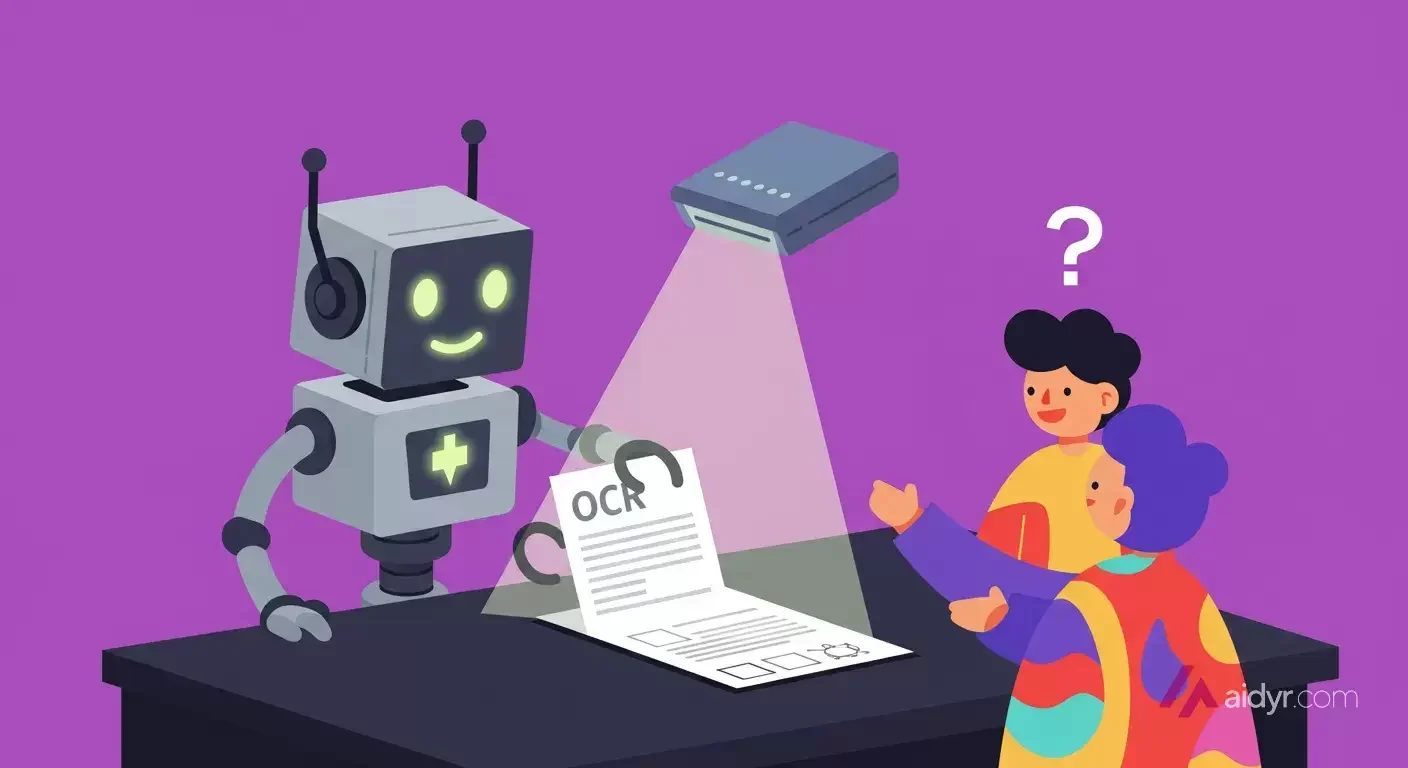
PDF files are like digital safes that contain crucial information, but extracting that data has been a real headache for data experts and companies alike. Although these digital documents are essential for storing everything from scientific research to government records, their rigid format frequently traps the data, complicating their reading and analysis by machines.
Derek Willis, a Data Journalism instructor at the University of Maryland, points out that part of the problem lies in the fact that PDFs were conceived at a time when print design dominated publishing software. Many of these documents are, in essence, images of information, which means that Optical Character Recognition (OCR) software is required to convert those images into data, especially if the original is old or includes handwriting.
A look at the history of OCR
The technology of optical character recognition has existed since the 1970s and was popularized by Ray Kurzweil, who developed commercial systems that facilitated text reading for blind individuals. Although traditional OCR is effective with clear and simple documents, it often fails with unusual fonts, multiple columns, tables, or low-quality scans.
Despite its limitations, traditional OCR remains common in many workflows due to its reliability. However, with the rise of large language models (LLMs), companies are seeking new ways to approach document reading.
The arrival of language models in OCR
Unlike traditional OCR methods, multimodal LLMs are designed to analyze text and images, processing documents in a more comprehensive manner. For example, ChatGPT can read a PDF file uploaded to its interface, addressing both textual content and visual elements simultaneously.
Willis has observed that LLMs that excel in these tasks tend to behave more similarly to how a human would. Although some traditional OCR systems, such as Amazon Textract, are effective, LLMs offer an advantage by considering a broader context when interpreting unusual patterns in documents.
New initiatives in LLM-based OCR
With the growing demand for document processing solutions, new companies are emerging in the market. Mistral, a French company, has launched Mistral OCR, an API specialized in document processing.
Willis highlights that Google currently leads the field with its Gemini 2.0 model, which has proven to handle complicated documents with a minimal number of errors, thanks to its ability to process lengthy documents and its robust handling of handwritten content.
Challenges of LLM-based OCR
Despite the promises of LLMs, they present new issues in document processing. These models can generate confusions or “hallucinations,” where they produce plausible but incorrect information. Willis warns that LLMs sometimes omit lines in larger documents, an error unlikely in traditional OCR systems.
The incorrect interpretation of tables, especially in financial or medical documents, can have serious consequences, meaning that careful human oversight is often required. LLM-based OCR tools must be used with caution, as blind trust in their accuracy can lead to costly mistakes.
Despite advancements, there is still no perfect OCR solution. The race to liberate data from PDFs continues, with companies like Google exploring generative artificial intelligence products that are context-aware. As these technologies improve, they could unlock a vast potential of knowledge that remains trapped in digital formats, opening new opportunities for data analysis.
In IT since 2002: systems, engineering, web development and SEO. I have been doing business with AI since February 2023, when ChatGPT could first be bought in Spain.

Anything left unclear? Ask me
I’m Miguel Ángel, and I’ll answer you myself, right here. And if something is out of date, tell me and I’ll fix it.