TTT-MLP: One-Minute Video Generation with Test-Time Training
9 min read
Price Nothing to pay and no account: the code is free on GitHub under the MIT license. The real cost is hardware,…
Checked on October 15, 2026
My verdict
In IT since 2002: systems, engineering, web development and SEO. I have been doing business with AI since February 2023, when ChatGPT could first be bought in Spain.
TTT-MLP isn't a video generator you can sign up for: it's a research project from NVIDIA, Stanford, UCSD, UC Berkeley and UT Austin, accepted at CVPR 2025. It added Test-Time Training layers to a pre-trained video model and got one-minute Tom and Jerry cartoons, each one generated in a single pass from a written storyboard. The training and inference code is public under the MIT license, but there's no app, and the weights behind the demo videos aren't published. Read it as a peek at where long AI video is heading, not as a tool for your next project.
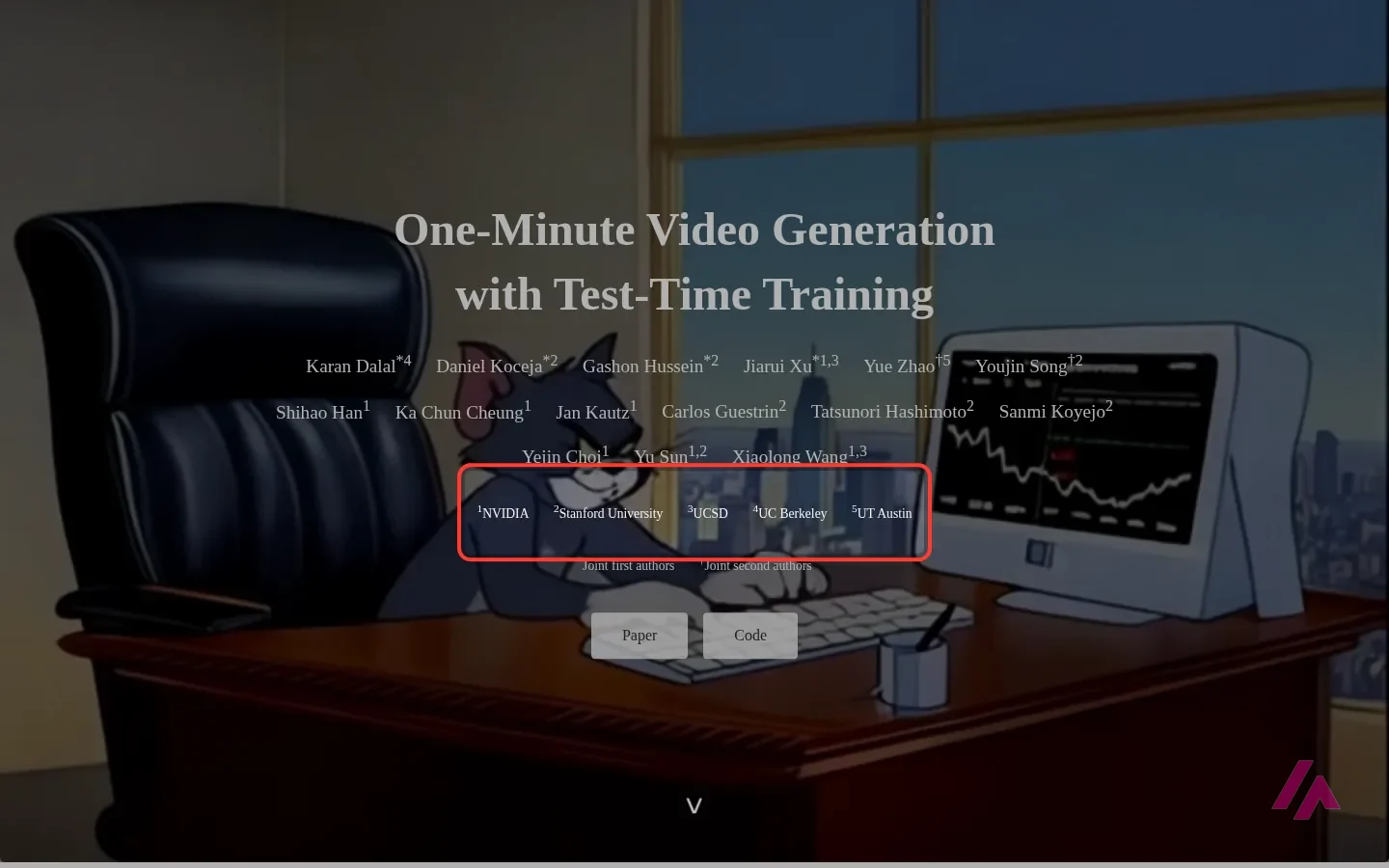
What is TTT-MLP
- Type
- Video
- Updated on
- Oct 15, 2026
TTT-MLP isn't an app you can open in your browser: it's a research project, "One-Minute Video Generation with Test-Time Training," accepted at CVPR 2025, by researchers from NVIDIA, Stanford, UCSD, UC Berkeley and UT Austin. They took CogVideoX 5B, a video model whose clips max out at 3 seconds, added Test-Time Training (TTT) layers, and fine-tuned it on Tom and Jerry cartoons until it could produce one-minute cartoons from a written storyboard, each in a single pass. The code is on GitHub under the MIT license, but there's no website to generate with and the finished model isn't published. So if you came here to make a long AI video today, skip to "Want a long AI video today?" below; if you want to know how they did it, stay with me.
What TTT-MLP actually is
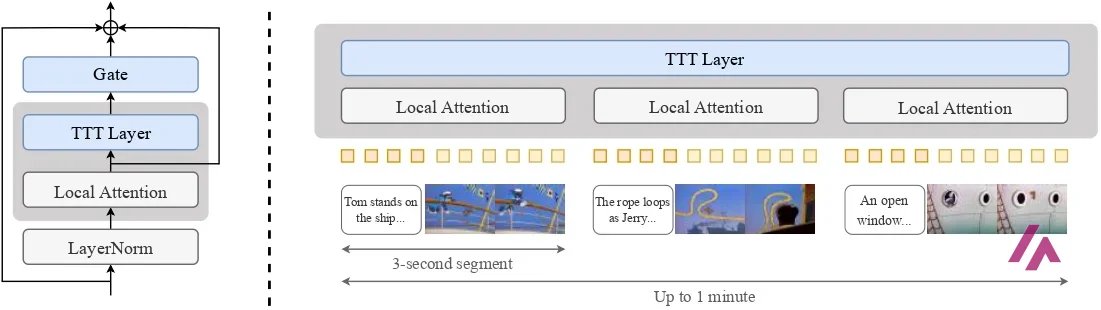
Fair warning: this part gets a little technical. The problem the paper attacks is length. A one-minute video takes over 300,000 tokens of context, and with standard self-attention, the authors write, generating a one-minute video would have taken longer than generating 20 three-second ones. Cheaper alternatives like Mamba layers exist, but their memory is simpler, and they struggle with stories that jump between scenes.
A TTT layer's memory is itself a small neural network that keeps learning as it reads the video, hence "test-time training." In TTT-MLP, that network is a two-layer MLP (a basic kind of neural network, nothing exotic). The model keeps CogVideoX's own attention working locally, inside each 3-second segment and its text, while the TTT layers run across the whole minute to keep Tom the same blue-gray from the first scene to the last.
Why Tom and Jerry
The dataset is deliberately narrow, so they could iterate fast: 81 Tom and Jerry episodes released between 1940 and 1948, about 7 hours in total, cleaned up with a super-resolution model and annotated by hand as storyboards, 3 seconds at a time. The model was then trained in stages, at 3, 9, 18, 30 and finally 63 seconds.
The prompts are the fun part. Click any demo on the project page and you get the full storyboard: "Jerry, the brown mouse, sits upright on the kitchen table, holding a small block of yellow cheese in both paws," and so on, scene after scene. The paper says each video comes straight out of the model, with no editing, stitching or post-processing. Training wasn't cheap, though: the equivalent of 50 hours on 256 NVIDIA H100 GPUs.
How it did against Mamba 2 and Gated DeltaNet
The authors compared TTT-MLP with other ways of handling long context, using a human evaluation of 100 videos per method, scored in Elo points (the rating system from chess, also used to rank chatbots). These are the paper's numbers for the one-minute videos:
| Method | Text following | Motion naturalness | Aesthetics | Temporal consistency | Average |
|---|---|---|---|---|---|
| Mamba 2 | 985 | 976 | 963 | 988 | 978 |
| Gated DeltaNet | 983 | 984 | 993 | 1004 | 991 |
| Sliding-window attention | 1016 | 1000 | 1006 | 975 | 999 |
| TTT-MLP | 1014 | 1039 | 1037 | 1042 | 1033 |
That's a 34-point lead on average over the runner-up. Notice that sliding-window attention edged it out on text following. And the paper is honest about the rest: in an earlier round with 18-second videos, Gated DeltaNet came out on top, ahead of TTT-MLP by 28 points, and TTT-MLP is still slower than Gated DeltaNet and Mamba 2 at both training and generating.
The artifacts the authors admit
Look closely and the cartoons wobble. The project page has a whole Limitations section, and I like that it's right there for anyone to see:
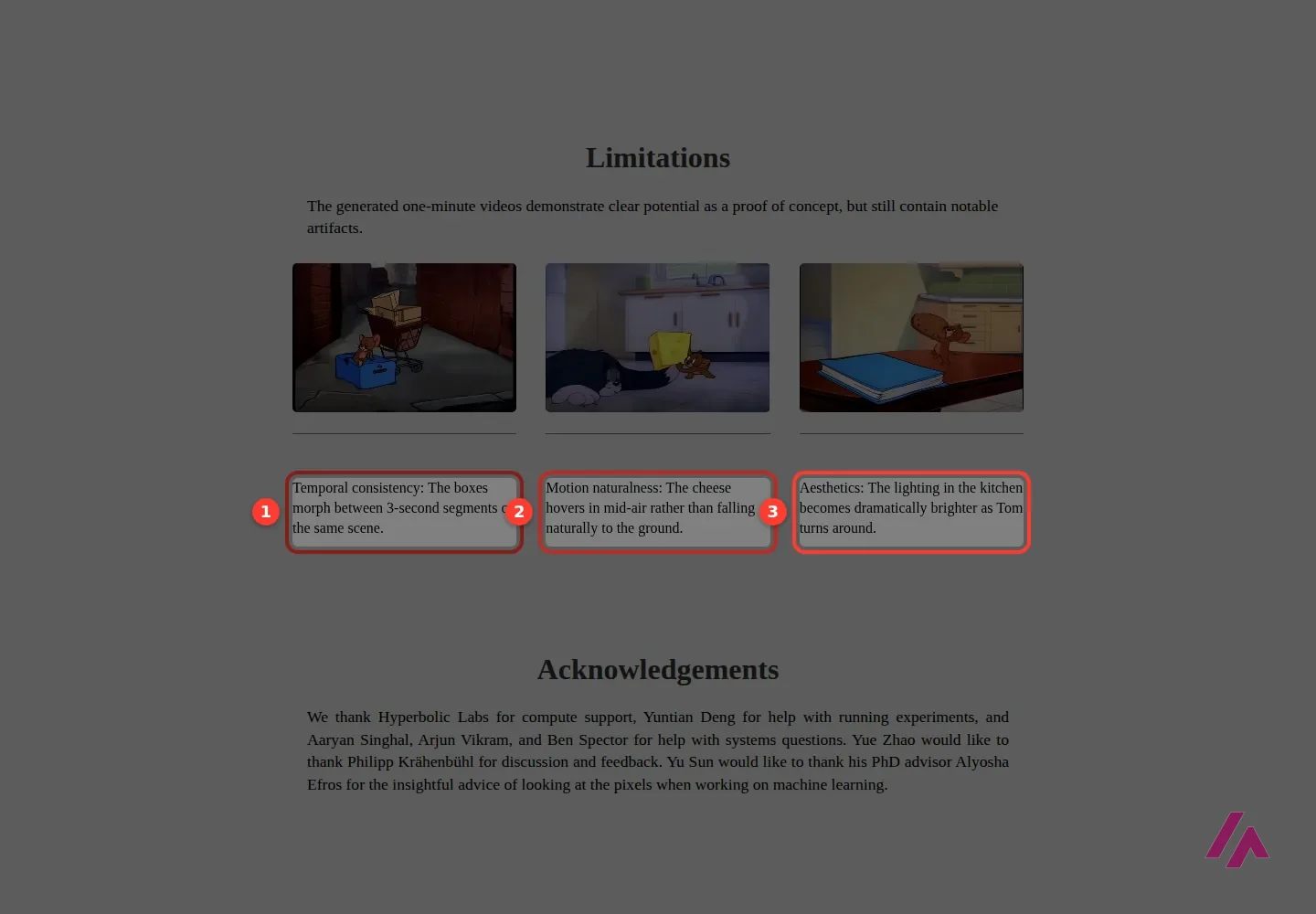
In the paper, they add that these artifacts show up with every method they tested, and that they're likely due to the limited capabilities of the 5B base model. In other words, a bigger base model could fix some of it, but that's their hypothesis, not a result.
Research, not a product (Heads-up)
There's no TTT-MLP website where you type a prompt and get a minute of video. What exists is a paper, a project page with demo videos and a GitHub repository for researchers with powerful GPUs.
What's on GitHub, and what isn't
The official repository, test-time-training/ttt-video-dit, holds the PyTorch code for training and inference of 63-second videos, under the MIT license (free to use and modify). Two notes in the README matter more than anything else on the page:
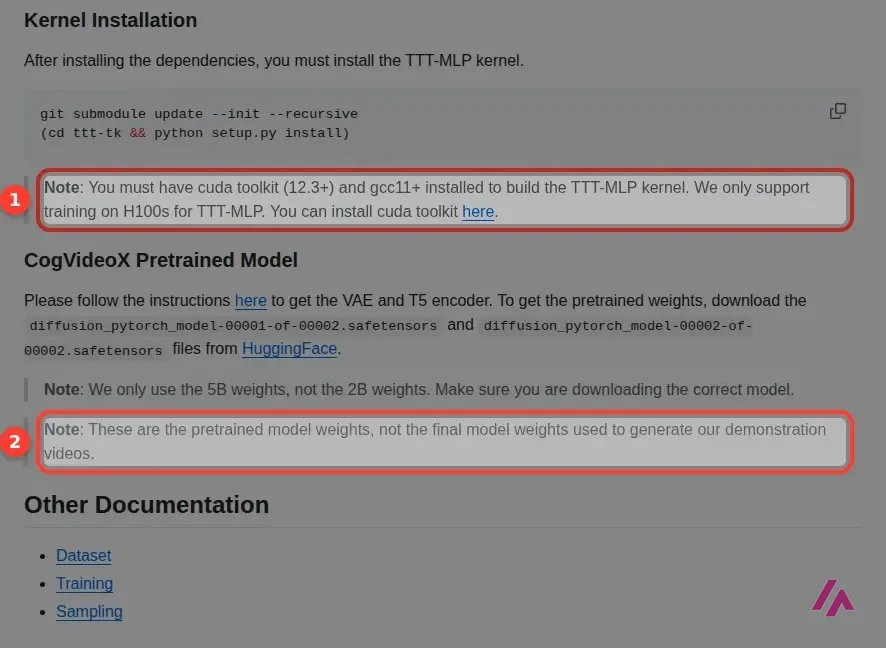
So you start from CogVideoX's 5B weights and train the rest yourself, with the CUDA toolkit 12.3 or later to build the TTT-MLP kernel, and H100 GPUs (the authors' own run took the equivalent of 50 hours on 256 of them). Also, the training annotations are gone from the README: the link to the Tom and Jerry text annotations was removed in February 2026, in a commit titled "Comply with DMCA." That's the repository's most recent commit; before that, the last update was a license file in June 2025.
The demo model isn't public (Important)
The README says it plainly: the weights you download are the pretrained CogVideoX ones, not the final weights used to make the demo videos. So no app or website you find today runs the model behind those demos.
What comes next is up to the authors. In the paper they write that they only tried one-minute videos because of resource limits, and that the approach could be extended to longer videos, with larger networks as the memory. That's a direction, not something you can use.
Want a long AI video today?
Here's the practical part. The video tools below work in short clips (5 to 10 seconds in the examples from my reviews), so a minute means writing a storyboard of shots and stitching them together. The TTT team wrote their storyboards in 3-second segments too, but their model turned the whole storyboard into one minute in a single pass. Prices and credits are as of my reviews in early October 2026:
- Kling AI: the free plan gives you 66 credits a month, and a 5-second 720p clip without sound costs 30. Kling lists multi-shot storytelling among VIDEO 3.0's features. Standard is $6.99 the first month, then $8.80 a month.
- Google Flow: a Google Account gets you 50 free credits a day, about two Veo 3.1 Fast videos. A Veo 3.1 Quality video is 8 seconds for 100 credits (more than a day's free credits), and Flow's Storyboard Studio turns a script into a cast and a storyboard. Paid plans start at $4.99 a month.
- Runway: 125 free credits, once, about two 5-second Gen-4.5 clips. The $15 Standard plan covers about 52 seconds of Gen-4.5 a month, and it's the one to pick if you want to extend and restyle your shots too.
- Higgsfield: Kling, Seedance, Sora, Veo and its own models under one account. The free plan has no monthly credits; Starter is $19 a month.
My pick for a first minute on a budget: Google Flow, because its credits refill every day, although free video generation may be unavailable at peak hours. And keep an eye on research like this, because the day a long-video model like TTT-MLP lands in one of those apps, the chaining won't be your problem anymore. 🎬
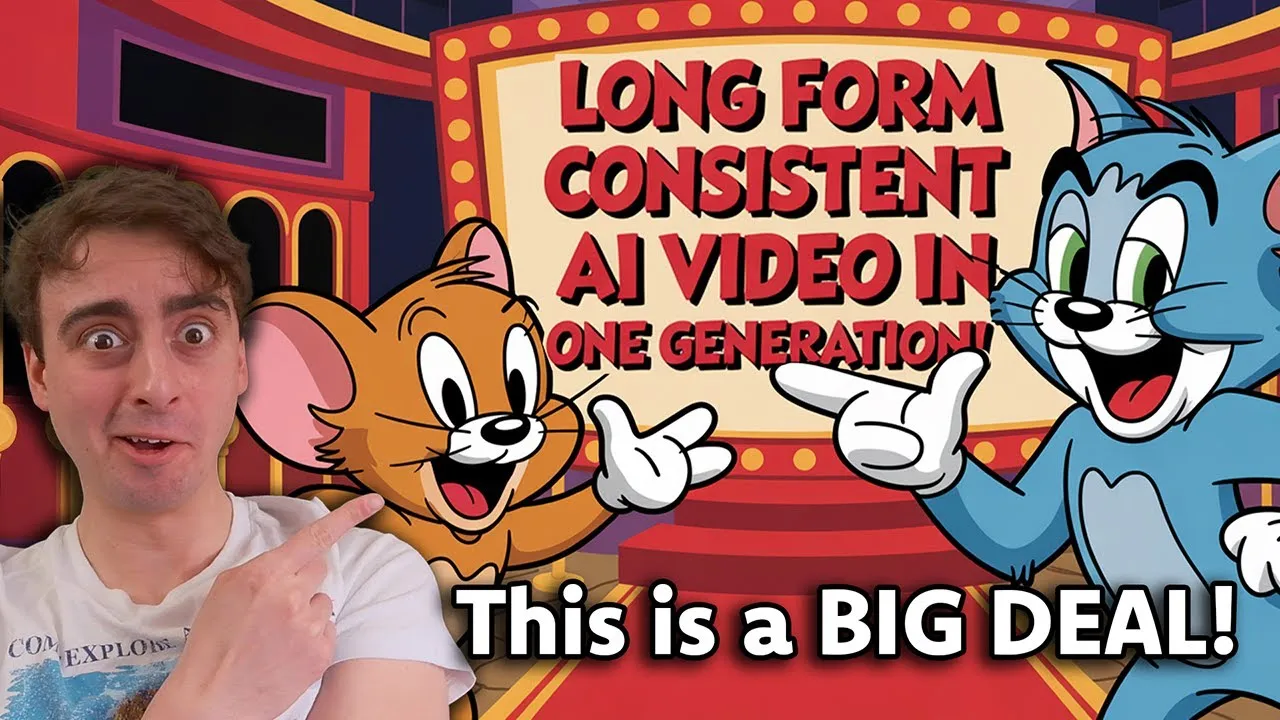
MattVidPro, an AI and tech channel, goes through the paper and its demo videos the day after it came out, so you can see the one-minute cartoons with someone talking you through them. The description links to the project page, the code and the PDF, plus his Discord and a Descript referral link.
Who is it for? For researchers, ML engineers and curious readers who want to understand how AI video could get past short clips. If you want a long video for your channel or your client this week, the tools under "Want a long AI video today?" are the ones you can actually use.
What I like and what I don’t
What I like
- In the authors' human evaluation of 100 videos per method, TTT-MLP led the second-best method by 34 Elo points on average.
- The code is on GitHub under the MIT license, with training and inference for 63-second videos.
- The project page shows every demo video with the full prompt used to make it.
What I don’t
- There's no app, no website to generate with and no download of the final model behind the demos.
- The authors themselves point out artifacts: objects that morph, cheese that floats in mid-air, lighting that jumps.
- Training needs serious hardware: the repository only supports training TTT-MLP on NVIDIA H100 GPUs.
Have you used TTT-MLP? Tell me how it went
What worked for you and what didn’t. Your experience helps the next person who lands here unsure more than any review page. I read every one before publishing.
Write my review
TTT-MLP pricing
Nothing to pay and no account: the code is free on GitHub under the MIT license. The real cost is hardware, since training TTT-MLP is only supported on NVIDIA H100 GPUs.
Checked on October 15, 2026. That’s the price I put on this page, and these change often: check it on their site before you pay.
Alternatives to TTT-MLP
-

Kling AI
Free with limits · from $8.80/mo
When to pick it: If you want to start for free: 66 credits a month, and Kling lists multi-shot storytelling among VIDEO 3.0's features.
See details → -
Google Flow
Free with limits · from $4.99/mo
When to pick it: If you have a Google Account: 50 free credits a day, plus Storyboard Studio to turn a script into a cast and a storyboard.
See details → -
Runway
Free with limits · from $15/mo
When to pick it: If you want to generate clips and then edit, extend and restyle them in the same place.
See details → -
Higgsfield
Free with limits · from $19/mo
When to pick it: If you'd rather compare several video models under one subscription.
See details →
How I tested it
On October 15, 2026 I read the paper on arXiv, went through the project page (its demo videos, the prompt behind each one, the comparison clips and the limitations section) and read the official GitHub repository: the README, the license and its commit history. TTT-MLP is research, not a service you can log in to, so there was no account to open; the code is there for anyone with the hardware to run it. The screenshots in this review come from the project page and the repository.
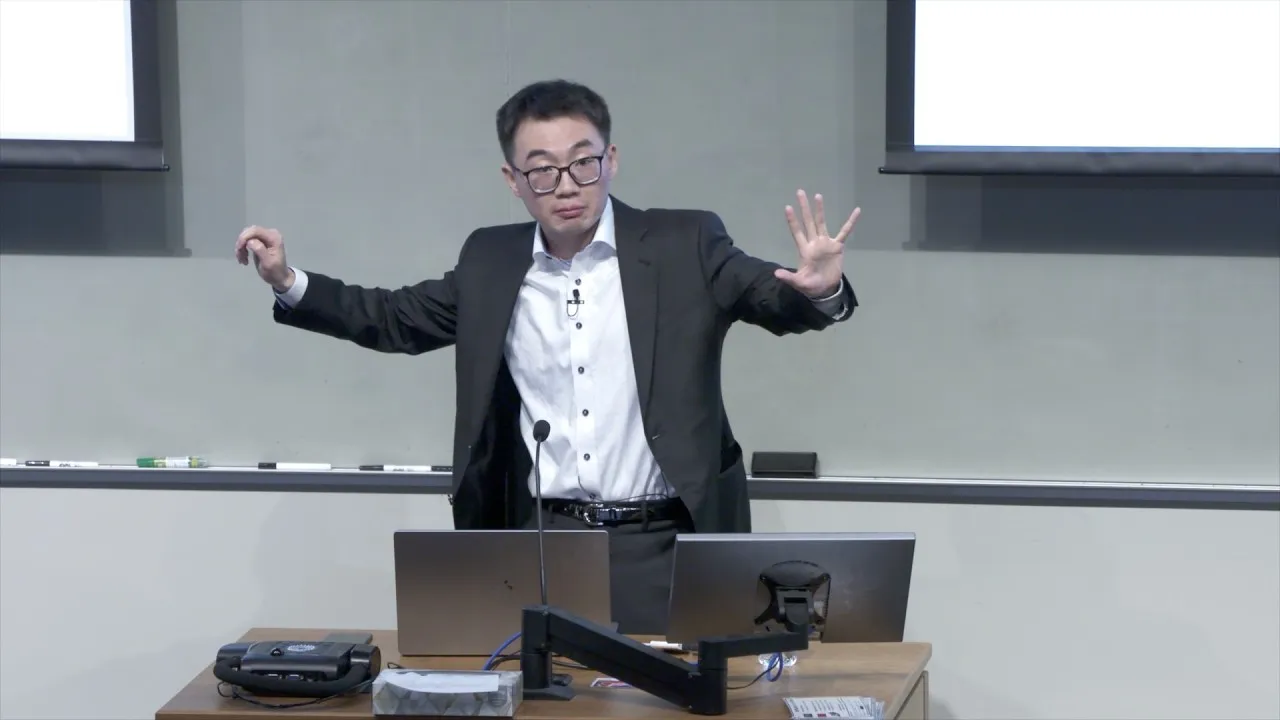
If the idea of a model that keeps learning while it works hooks you, here's Yu Sun, one of the paper's authors, giving an hour-long colloquium talk on test-time training at the Paul G. Allen School. It's about the framework as a whole, from long-term memory that scales with context length to helping AI find new results on open scientific problems.

Written by Miguel Ángel, with the help of an LLM to fact-check. In IT since 2002 (systems, engineering, web development and SEO), doing business with AI since February 2023, when ChatGPT could first be bought in Spain. I build, write and maintain this site myself.

Got a question? Ask me
About TTT-MLP, its plans or whether it fits what you need. I’m Miguel Ángel, and I’ll answer you myself, right here.