
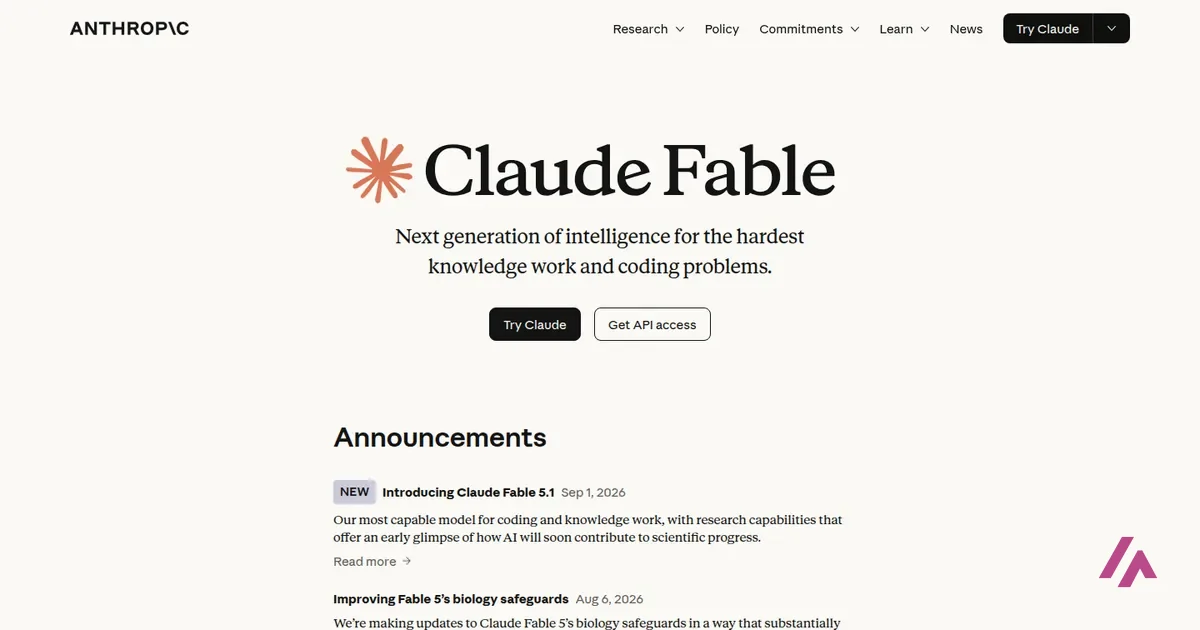

What is Claude Fable 5.1? It's the most capable model in Claude's lineup, released by Anthropic on September 1, 2026, and built for the long, hard jobs: coding agents that run for hours, multistep research, and turning a pile of documents into a finished report or spreadsheet. You get it on Pro (paid on top, through usage credits), Max (up to 50% of your weekly limits), Team premium seats and Enterprise, but not on the Free plan. On the API it costs $10 per million input tokens and $50 per million output tokens, which is 2.5x the price of Opus 5.5.
One thing worth knowing before you get excited: Anthropic's own documentation says that, for most workloads, you should start with Opus and move to Fable for the hardest, longest jobs or when Opus falls short. After trying both, I agree.
I'm Miguel Ángel, and I wrote this with help from an LLM to verify facts. I checked every price (in US dollars) and every plan on Anthropic's pages on September 29, 2026, and I ran Fable 5.1 myself from Claude Code on my Max plan.
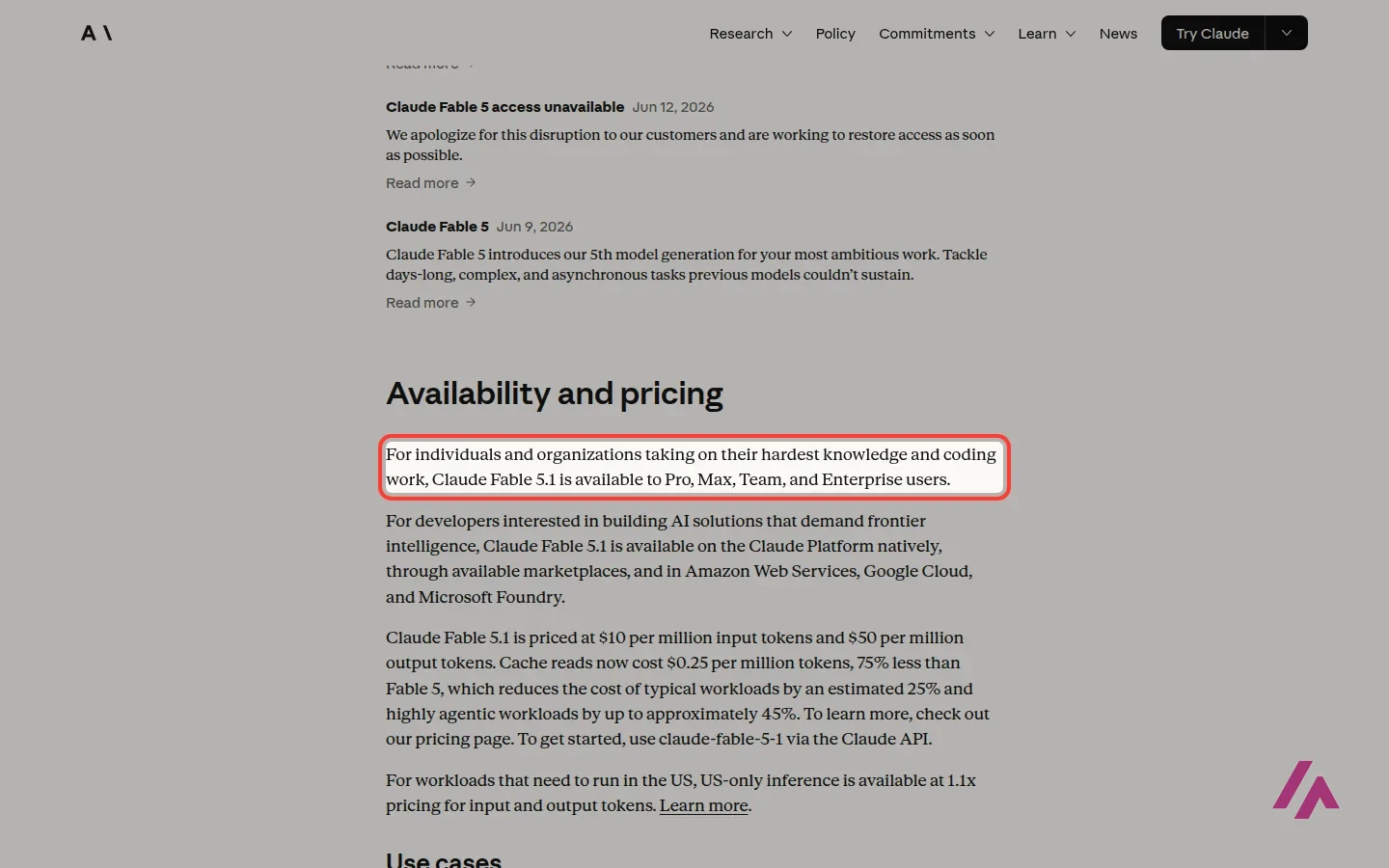
Where Fable fits in the Claude lineup
Anthropic currently offers four models, and they're easiest to picture as a ladder: each step up is smarter, slower and pricier. Fable sits at the top.
| Model | Input / output | Speed | Context window | Best for |
|---|---|---|---|---|
| Fable 5.1 | $10 / $50 | Slower | 1M tokens | Long-running agents, the hardest reasoning |
| Opus 5.5 | $4 / $20 | Moderate | 1M tokens | Serious coding and most professional work |
| Sonnet 5.5 | $2 / $10 | Fast | 1M tokens | Everyday work at a good price |
| Haiku 5.5 | From $0.10 / $0.50 | Fastest | 1M tokens | Quick, cheap, high-volume tasks |
From Anthropic's model documentation. Batch processing halves these prices.
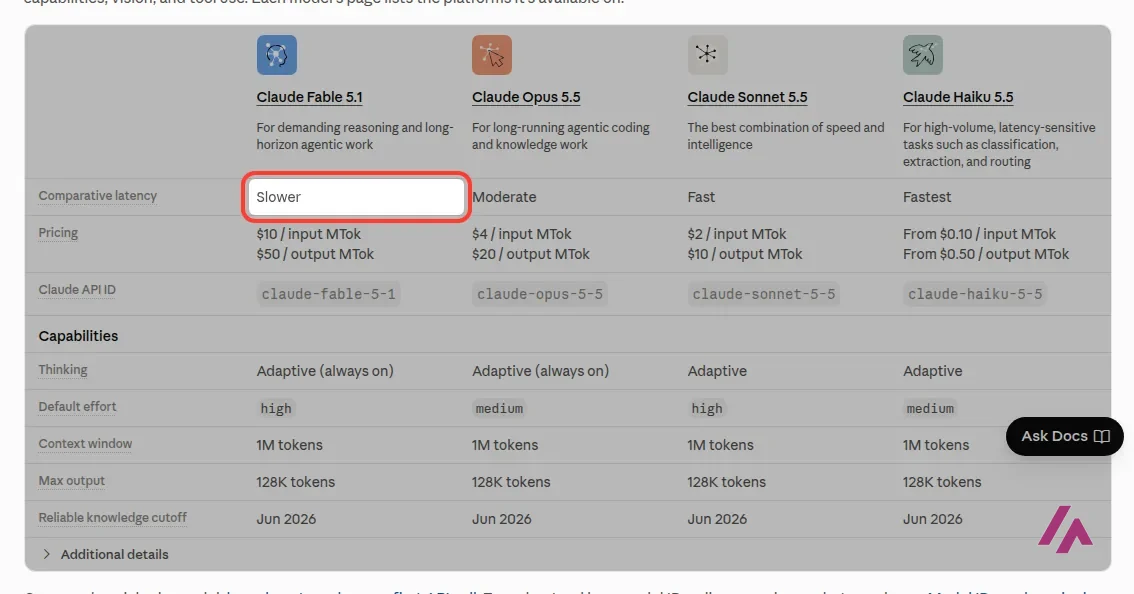
A 1M-token context window means you can hand it an entire codebase or a stack of long PDFs in one go. Fable also thinks before every answer (you can't switch that off), and on the API its default effort is high, while Opus 5.5 defaults to medium. In other words, out of the box it's set up to think hard, not to answer fast.
Anthropic's short launch video for Fable 5.1, from September 1, 2026: what the model is built for (long, multistep work like a long mathematical proof or a contract with hundreds of cross-references) and Anthropic's claim that, at lower effort levels, it can get results similar to or better than Fable 5 at a much lower cost. It's the maker presenting its own model.
Which Claude plans include Fable 5.1
This is where most people get confused, because "available on Pro" doesn't mean the same thing as "included in Pro".
| Plan | Price | Fable 5.1 |
|---|---|---|
| Free | $0 | Not available |
| Pro | $20 a month ($17 a month billed annually) | Only through usage credits, paid on top |
| Max 5x | $100 a month | Up to 50% of your weekly limits |
| Max 20x | $200 a month | Up to 50% of your weekly limits |
| Team | $25 a seat a month ($20 billed annually); premium seats $125 ($100 billed annually) | Premium seats only, up to 50% of weekly limits |
| Enterprise | $20 a seat a month, billed annually, plus usage | Yes |
Plan prices exclude tax. Usage credits are billed at standard API rates.
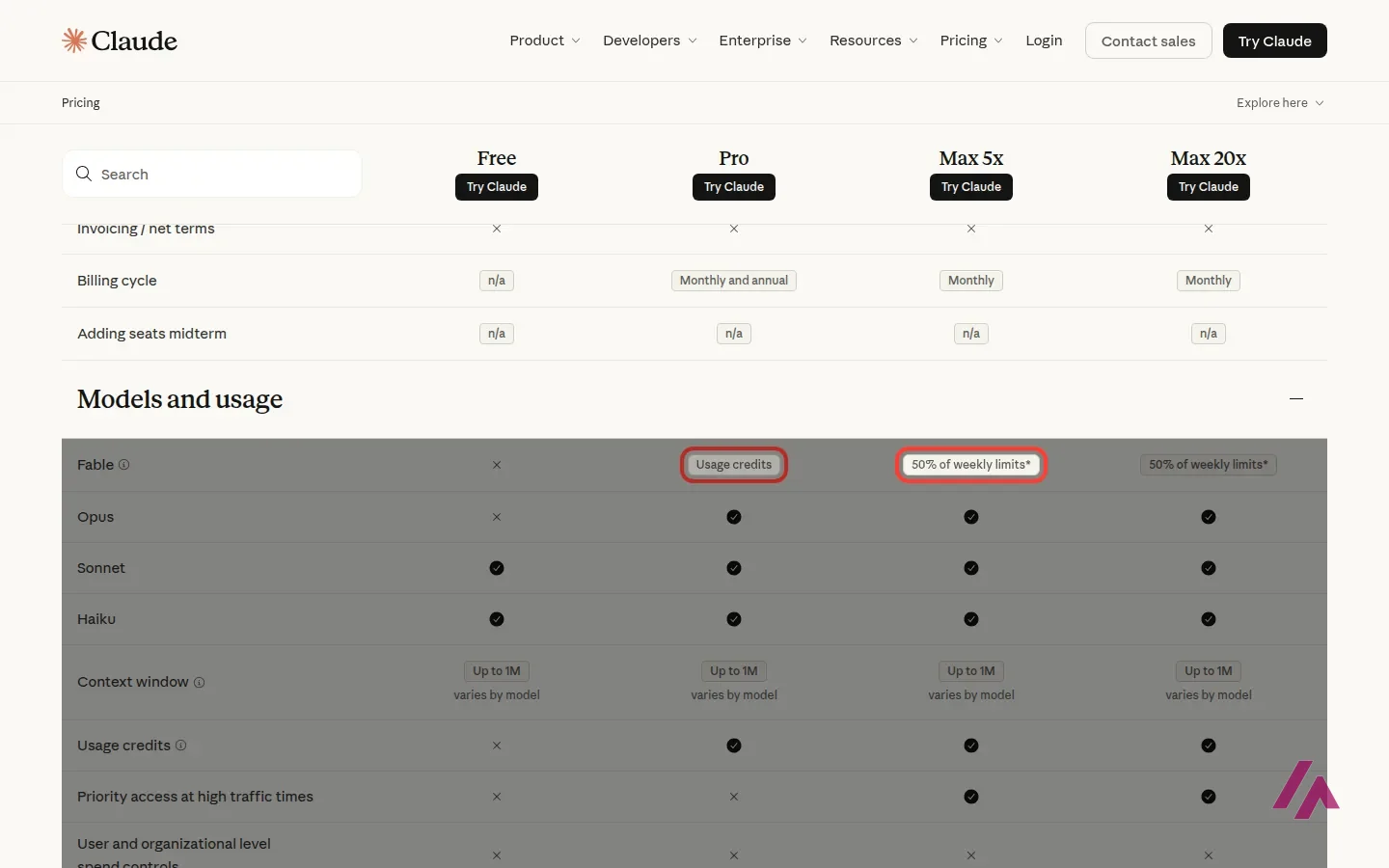
In plain English:
- On Pro, your $20 doesn't buy you any Fable. You can turn on usage credits and pay API rates for it, so every Fable conversation is billed on top of your subscription.
- On Max, Fable is part of the plan, but it can only use up to half of your weekly limits. Anthropic says the model you pick affects how fast you burn through your allowance, so a Fable-heavy week is likely to drain it sooner than an Opus-heavy one.
- On Team, only premium seats get it.
Check Settings > Usage before a long Fable job (Tip)
If you're on Max and about to hand Fable a job that will run for hours, look at Settings > Usage first. Claude's pricing page says that's where you can see where you stand at any time, so you'll know how much of your week is left before Fable starts eating into it.
If you're thinking of upgrading just for Fable, my Claude pricing guide explains what else changes between Pro and Max.
I gave Fable 5.1 and Opus 5.5 the same bug
I didn't want to write about Fable based only on Anthropic's pages, so I gave both models the same small, very ordinary problem at the same time: a few lines of Python that build a price table, where the annual Pro price "never shows up". The real cause is a classic: the code stores each plan under its name only, so the monthly Pro price quietly overwrites the annual one.
Here's what came back:
- Fable 5.1 found the root cause (the price is calculated and then lost), fixed it by keying each price on both the plan name and the billing period, and warned me about two things that would bite later: any billing value other than exactly "annual" would silently be treated as monthly, and handling money as floats and rounding them invites rounding errors.
- Opus 5.5 found the same cause, gave the same fix and the same warning about money, and went one step further on the other one: it built the check into the code, so an unknown billing value now raises an error instead of slipping through.
Fable was also a bit slower to answer. So on a small, everyday task, I couldn't tell them apart on quality, and Opus was, if anything, the more practical of the two. That's not a knock on Fable: a small bug like this one is simply not what it's for. Anthropic positions it for work that runs for hours across many files, where the gap between the two is supposed to show. For a short question, you're paying premium prices to wait longer.
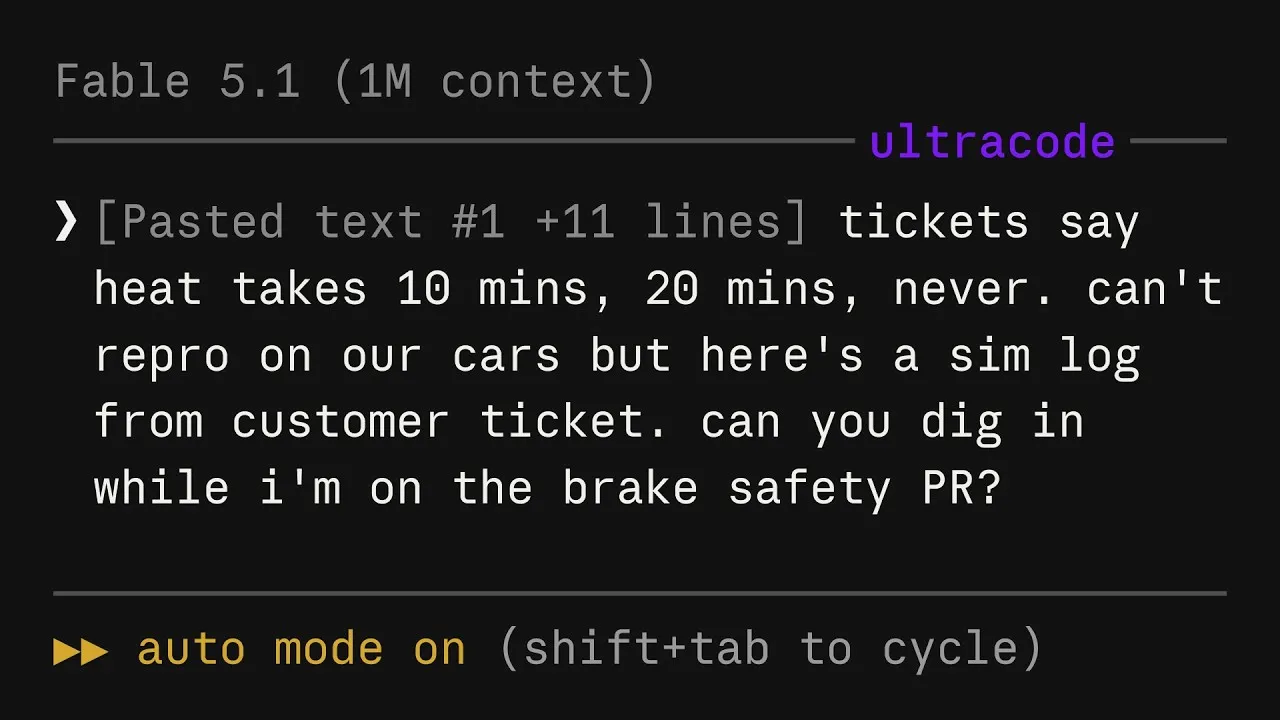
Anthropic's example of the long engineering work it positions Fable for: the model goes through months of vehicle data, support tickets and several codebases to track down a bug the team couldn't reproduce internally, proposes a cause, and a developer confirms it, decides what's safe to ship and approves the fix. It's a demo from the maker, not an independent test.
What changed from Fable 5
Fable 5.1 replaces Fable 5, which launched on June 9, 2026. Fable 5 had a bumpy start: on June 12, Anthropic suspended access to it for everyone after the US government imposed export controls on Anthropic's newest models, and it came back on July 1 once the controls were lifted.
The 5.1 update keeps the same input and output prices and changes a few things that matter:
- Cheaper long sessions. Rereading cached context costs $0.25 per million tokens, 75% less than on Fable 5. Anthropic estimates typical workloads cost about 25% less and very agentic ones up to around 45% less.
- Better at the long stuff. Anthropic says the gains are in hours-long coding sessions, research that follows up on what it finds, reading dense charts and PDFs, and producing finished documents, spreadsheets and slide decks from scratch.
- Fewer false alarms in security work. Anthropic says its cybersecurity safeguards now block 60% fewer harmless requests by mistake, and Fable can now help find software vulnerabilities, though not build exploits for them.
- A different writing style. In chat it uses less bold, fewer headers and fewer lists than earlier Claude models, and its prose can be denser. When editing files, it's more likely to rewrite the whole file than to change a single line.
- Watermarked text. Everything Fable 5.1 writes carries Anthropic's statistical watermark. Anthropic says it doesn't change the meaning, quality or readability, and adds no hidden characters.
Dan Shipper, CEO of Every, on the week he spent testing Fable 5.1, published on launch day, with chapters on coding, knowledge work and writing. It's an early look from outside Anthropic, not an Anthropic video. The description promotes Every's own written review and a Fable prompt library on its site.

Fable 5.1 on the API: what a job actually costs
If you're a developer, the model ID is claude-fable-5-1, and it's also on Amazon Bedrock, Google Cloud and Microsoft Foundry. The context window is 1M tokens and a single answer can run up to 128K tokens.
| Item | Price |
|---|---|
| Input | $10 |
| Output | $50 |
| Cache write (5 minutes) | $12.50 |
| Cache write (1 hour) | $20 |
| Cache read | $0.25 |
Batch processing is 50% off: $5 input and $25 output. US-only inference costs 1.1x.
To make that concrete: a request that sends 100,000 tokens (a hefty chunk of code or a long report) and gets 10,000 tokens back costs about $1.50 on Fable 5.1 ($1 in, $0.50 out). The same request on Opus 5.5 costs about $0.60. Over a day of agent runs that difference adds up fast, which is why the cheaper cache reads (a quarter of Fable 5's price) are the headline for developers: agents reread the same context over and over.
Upgrading from Fable 5 on the API (Important)
Three changes can break existing code if you're moving from Fable 5: forcing it to call a specific tool now returns an error, earlier models can't read its saved reasoning, and editing earlier turns of a conversation invalidates that reasoning. Anthropic's migration guide walks through all three.
Fable 5.1 vs Mythos 5.1
You may see Claude Mythos 5.1 mentioned alongside Fable. According to Anthropic, they're the same model with different safeguards. Fable 5.1 is the one anyone can use. Mythos 5.1 is available only to approved organizations in trusted-access programs for cybersecurity and life sciences work, so unless your security team has been invited, Fable is the version you'll actually use.
So, should you pay for Fable?
My take, after using it: most people shouldn't go out of their way for it. If you're on Free, you get Sonnet, and it's good; the upgrade that actually matters is Pro, which gets you Opus. If you're on Pro, Opus 5.5 will handle almost everything you throw at it, and paying usage credits for Fable only makes sense for the occasional monster task.
Fable earns its price when the job is long and expensive to get wrong: an agent refactoring a large codebase overnight, a research task that has to chase down sources on its own, or an analysis that turns 300 pages of filings into a spreadsheet you'll actually trust. If that's your daily work, Max is the plan that makes Fable part of the deal rather than an extra bill. For everything else, keep Opus as your default and switch to Fable when Opus gets stuck, which is exactly how Anthropic suggests using it.
In IT since 2002: systems, engineering, web development and SEO. I have been doing business with AI since February 2023, when ChatGPT could first be bought in Spain.
Related guides
-
Tools
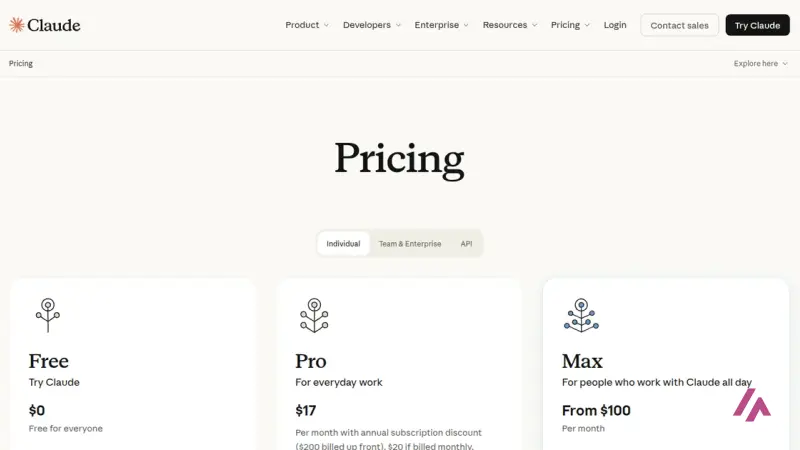
Claude Pricing: Free, Pro, Max, Team and API Costs, Explained
Claude costs $0, $20, $100 or $200 a month for individuals, $20 to $125 a seat for teams, and pay-per-token on the API. Here's what each plan actually…
-

Tools
Higgsfield MCP: How to Connect It and What It Costs
Higgsfield MCP lets Claude or ChatGPT make images and videos with your Higgsfield account. It takes a paid plan and always spends credits, even if…
-

Business applications
MCP: the magic bridge that connects AI with the real world
Can you imagine if your favorite chatbot could read your Google Drive files, send messages via Slack, or even modify documents on your computer…


Anything left unclear? Ask me
I’m Miguel Ángel, and I’ll answer you myself, right here. And if something is out of date, tell me and I’ll fix it.