
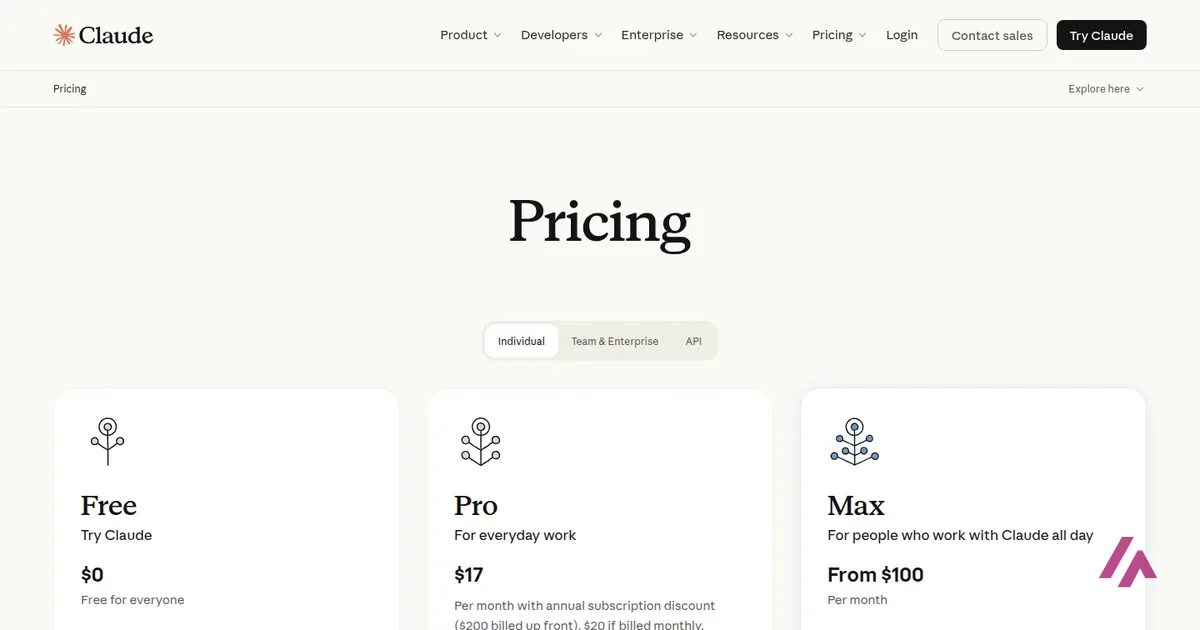

How much does Claude cost? In the US, Claude has a Free plan at $0, Pro at $20 a month (or $17 a month if you pay $200 for the year), and Max at $100 or $200 a month for 5x or 20x the usage of Pro. For companies, Team seats cost $25 a month ($20 billed annually), premium Team seats $125 ($100 billed annually), and Enterprise is $20 a seat per month billed annually, plus usage at API rates. Developers pay per token on the API, from $0.10 in / $0.50 out per million tokens (Haiku 5.5, on prompts up to 100,000 tokens) up to $10 / $50 (Fable 5.1, the most capable model on the list). Plan prices exclude tax.
And yes, Claude is free to use, with limits that I'll spell out below: the free plan is more generous in some places than you'd expect and stingier in others.
I'm Miguel Ángel, and I wrote this with help from an LLM to verify facts. I checked every price on Anthropic's pricing page and Help Center on October 10, 2026, in US dollars. Small confession: I'm in Spain, and the page showed me euros the first time, because it picks the currency from where your browser connects. If you're outside the US and the numbers don't match mine, that's why; the US version is the one below.
What changed on October 7 (Important)
Three things changed what you pay, all on the same day. Haiku 5.5 arrived as the new cheapest model, at a tenth of Haiku 4.5's price on prompts up to 100,000 tokens. Sonnet 5.5's cache reads dropped to half price. And Max and Team now come with monthly API credits: $100 on Max 5x, $200 on Max 20x and up to $500 pooled across a Team plan. Everything below already includes these changes.
Claude plans and prices at a glance
| Plan | Price | Claude Code | Who it's for |
|---|---|---|---|
| Free | $0 | No | Trying Claude, occasional questions, light writing |
| Pro | $20/month, or $17/month billed annually ($200 a year) | Yes | Daily use for work or study |
| Max 5x | $100/month | Yes | You hit Pro's limits several times a week |
| Max 20x | $200/month | Yes | You work in Claude, or Claude Code, all day |
| Team (standard seat) | $25/seat monthly, $20/seat billed annually | Yes | Small companies that need shared billing and admin |
| Team (premium seat) | $125/seat monthly, $100/seat billed annually | Yes | The heavy users inside that team |
| Enterprise | $20/seat/month billed annually + usage at API rates | Yes | Large organizations with SSO, SCIM, audit and compliance needs |
Max is billed monthly only. Team is for 2 to 150 people. Enterprise is annual only.
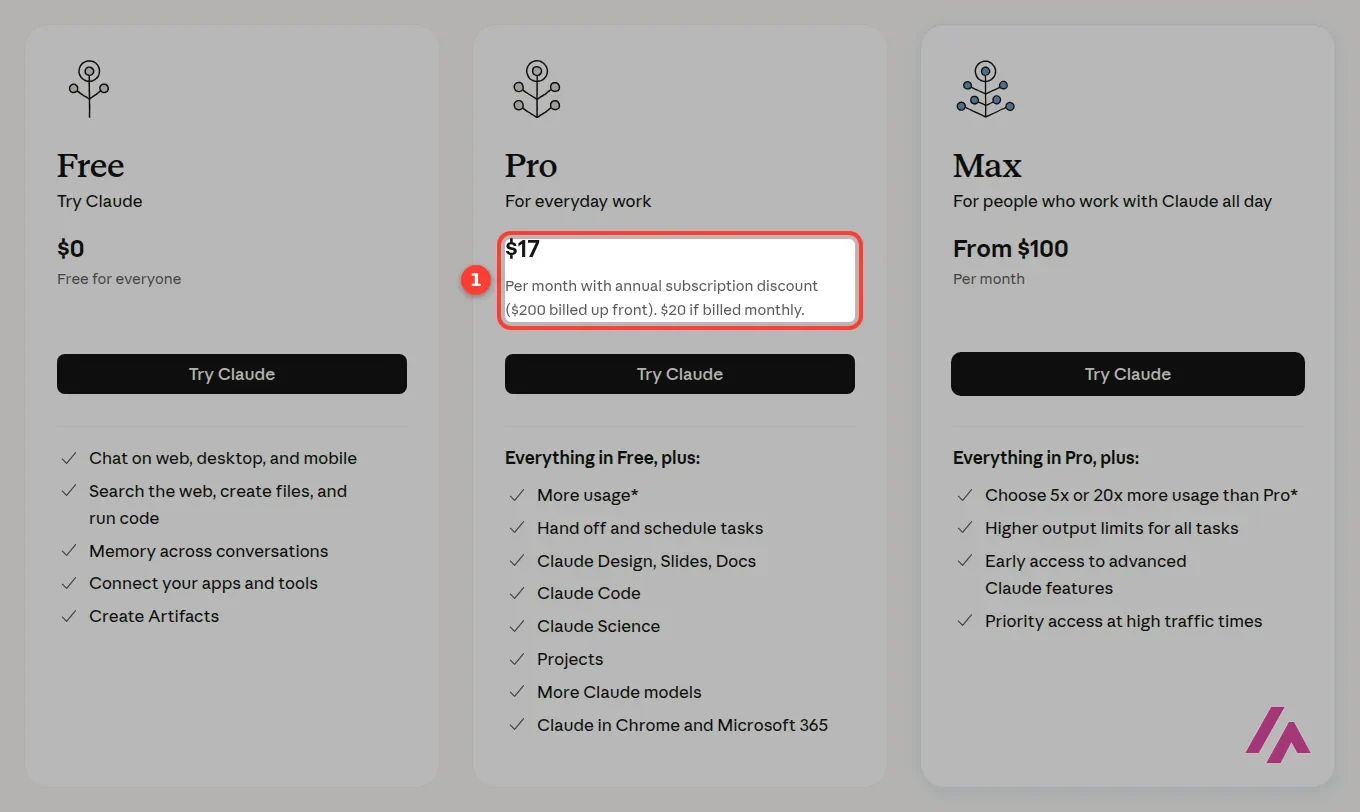
Two things on that page are easy to miss. First, the Max card only says "From $100": the $200 price of Max 20x is in Anthropic's Help Center, not on the card. Second, the fine print says prices don't include tax, so your card will show a bit more depending on where you live.
Is Claude free?
Yes. Anyone in a supported country can sign up at claude.ai with an email address and use Claude for $0. The Free plan keeps more than you might expect. According to the comparison table, on Free you get:
- Chat on the web, desktop apps, iPhone and Android.
- Web search, memory across conversations and voice mode.
- File creation and code execution, so Claude can create documents and run code for you.
- Artifacts, Skills, Connectors to your apps, and desktop extensions.
- Up to 5 Projects.
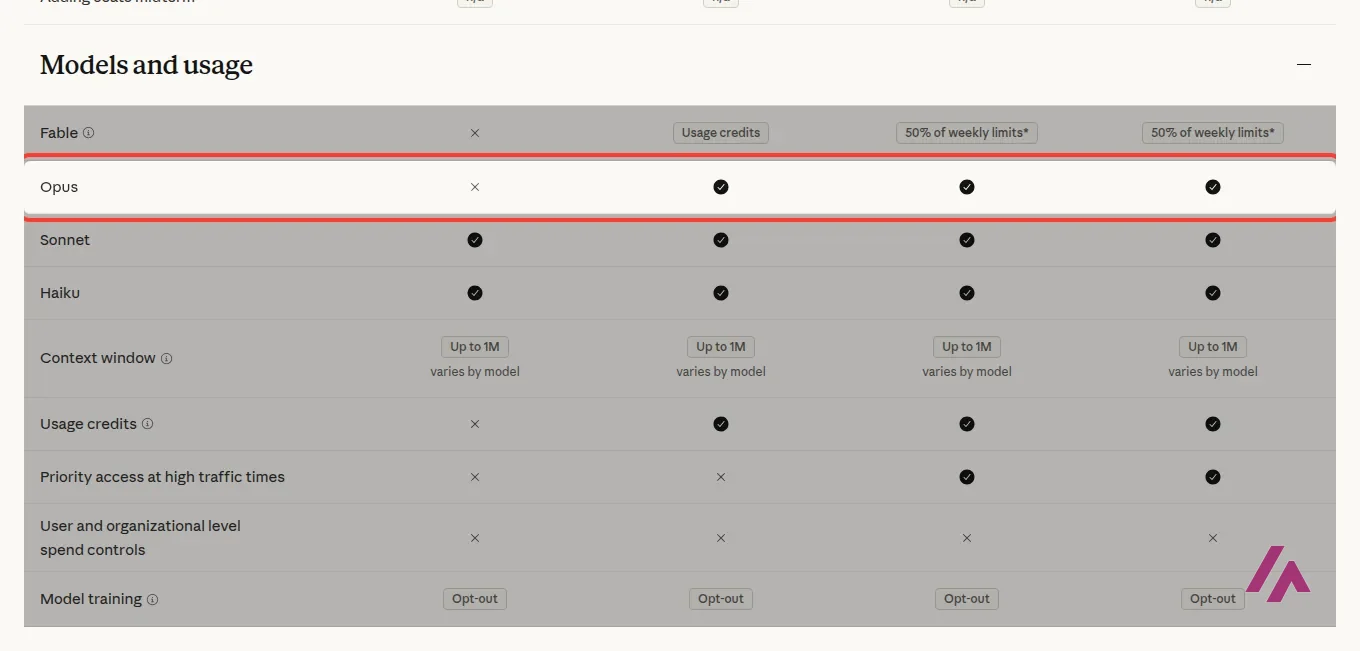
- The Sonnet and Haiku models, with a context window of "up to 1M" tokens that varies by model.
What Free doesn't include is where the upgrade pitch lives: no Opus and no Fable, no Claude Code, no Research, no Claude in Chrome or Microsoft 365, no Claude Design, Slides and Docs, and no usage credits to keep going once you run out.
The limit that matters on Free
Every Claude plan has usage limits that reset on a rolling five-hour window, and paid plans add a weekly limit on top. Anthropic doesn't publish a fixed number of messages: how far you get depends on how long your chats are, the files you attach and the model you pick. On Free, when you hit the wall, you wait for the reset. On paid plans you can buy usage credits and keep working at API rates.
My take: if you open Claude a few times a week to ask something, draft an email or summarize a PDF, Free is enough and paying would be buying limits you won't touch. The day you catch yourself waiting for the five-hour reset, or wanting Opus for a hard problem, that's your sign.
Free doesn't include Claude Code (Important)
If you came here because you want Claude in your terminal, the cheapest way in is Pro. On the Free plan, the Claude Code row in the comparison table is a flat "No".
One more thing about privacy, since it's free and people ask: on Free, Pro and Max, whether your chats are used to train models is an opt-out setting. On Team and Enterprise, the page says there's no model training on your content by default.
Claude Pro: what $20 a month buys
Pro is the plan most people should look at first. It's $20 a month, or $200 a year paid up front, which works out to $17 a month. For that you get everything in Free plus:
- More usage per five-hour session than Free (with a weekly limit on top).
- Opus, which Anthropic positions for agentic coding and enterprise work.
- Claude Code, sharing the same usage pool as your chats.
- Research, Projects without Free's cap of 5, and the option to hand off and schedule tasks.
- Claude Design, Slides and Docs, Claude Science, and Claude in Chrome and Microsoft 365.
- Fable only through usage credits, meaning you pay for it on top at API rates.
The catch Anthropic spells out in its Help Center: Pro doesn't include API usage. If you also want to build something with the Claude API, that's a separate account in the Claude Console with its own bill. Your $20 covers the apps and Claude Code, not your own software. Max and Team now include a monthly API credit (more on that below); Pro doesn't.
Is paying annually worth it? If you already know you'll use Claude for a year, paying $200 instead of 12 × $20 saves you $40. If you're not sure, go monthly for a month or two first: Anthropic says payments are generally non-refundable unless its terms or local law say otherwise, and a $200 impulse buy stings more than a $20 one.
When Pro runs out and Max pays off
Max comes in two sizes, both billed monthly only:
- Max 5x: $100 a month, which Anthropic describes as 5x the usage of Pro per five-hour session.
- Max 20x: $200 a month, 20x the usage of Pro.
On top of the extra usage, the page lists higher output limits, early access to new features, priority access at high-traffic times and access to Fable, capped at 50% of your weekly limits.
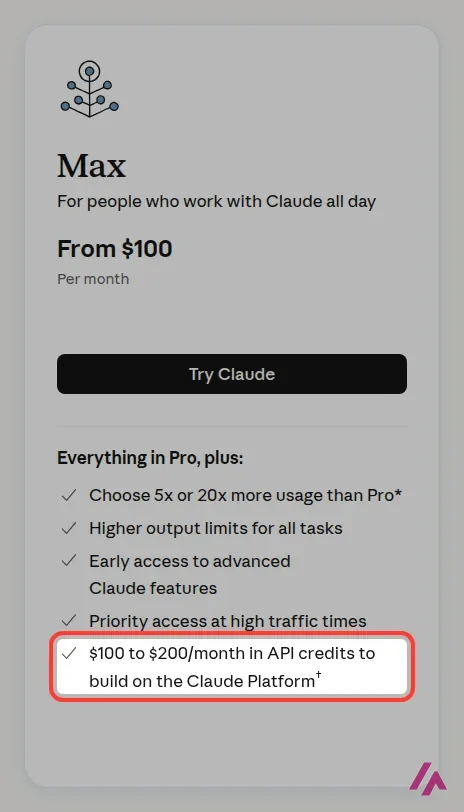
And there's a new line on the card: monthly API credits, $100 a month on Max 5x and $200 on Max 20x, to spend on the Claude Platform (Anthropic's API) on any model. If you were already paying for the API on the side, that changes the math: the plan now covers part of that bill. Three small print details from the Help Center: you claim the credits by linking a Claude Console organization, they don't roll over to the next month, and they don't pay for Claude Code sessions or extra usage.
Here's the math I find useful. Per five-hour session, Max 5x costs the same per unit of usage as monthly Pro: 5 times the price for 5 times the usage, so what you're buying is not being stopped halfway through the afternoon. Max 20x costs 10 times monthly Pro for 20 times the usage, so per session it's half the price per unit. Anthropic doesn't publish the weekly limits as multiples, so take that as a per-session comparison. And it only makes sense if you'd actually use it.
When I'd move up:
- You hit Pro's five-hour limit several times a week and you're using Claude for paid work. At that point, the $80 difference is probably worth it.
- You use Claude Code for hours at a time. It draws from the same pool as your chats, so long coding sessions and chatting add up against one limit.
- You want Opus as your default for long sessions rather than something you save for special occasions.
If you hit the limit once a week, don't upgrade yet. Anthropic says the model you choose affects how fast you use up your allowance, so save Opus for the hard problems and see how far Pro goes.
Before you jump to Max (Tip)
Pro already lets you turn on usage credits when you hit the limit and keep working at standard API rates. If that happens only now and then, paying for a few credits may cost you less than the $80 step up to Max 5x.
Which plan includes Claude Code?
All paid plans do: Pro, Max 5x, Max 20x, Team and Enterprise. Free doesn't. Claude Code runs every day on the server where I manage my websites, so the line that matters to me is in Anthropic's own FAQ: Claude Code shares the same usage limits as the rest of your plan. Your terminal sessions and your chats come out of one pool.
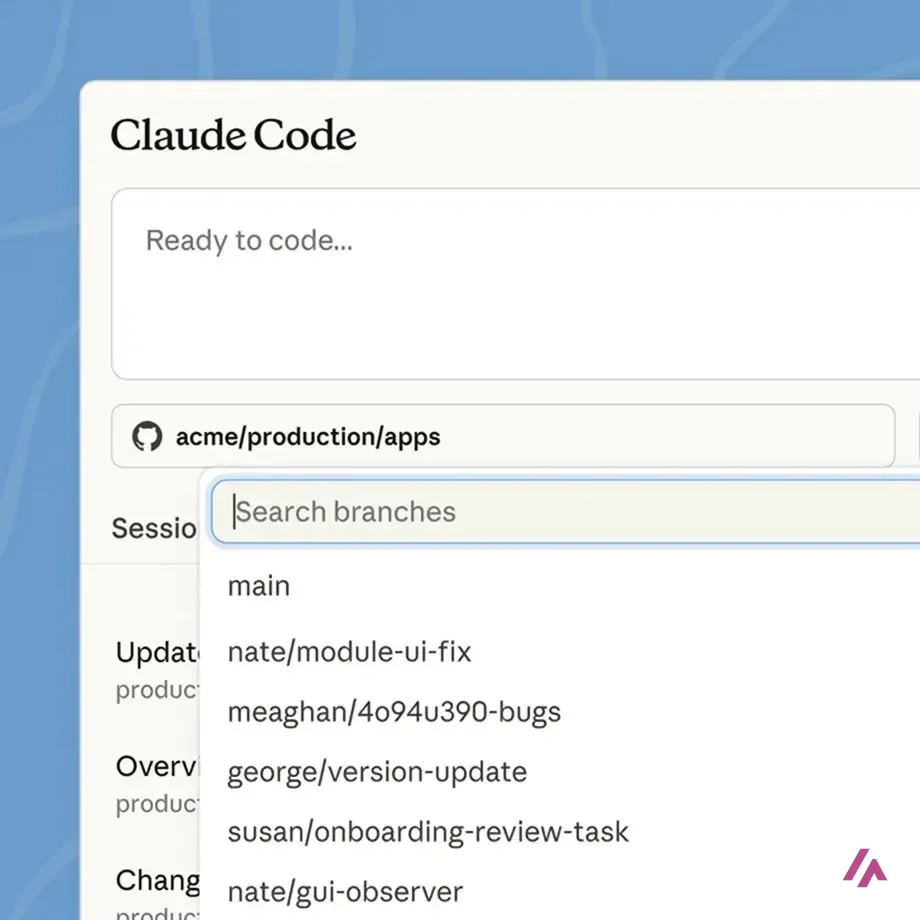
For very heavy coding, Anthropic also offers a way out of the subscription limits: pay-as-you-go API credits through a Console account. That turns your coding into a per-token bill (next section), which can be cheaper or much more expensive depending on how much you run it.
Claude Team and Enterprise pricing
| Plan | Billed annually | Billed monthly | What sets it apart |
|---|---|---|---|
| Team, standard seat | $20 | $25 | All Claude features, more usage than Pro, central billing, SSO, no training on your content by default |
| Team, premium seat | $100 | $125 | 5x the usage of a standard seat; Fable within 50% of weekly limits |
| Enterprise | $20 + usage at API rates | Not offered | SCIM, audit logs, role-based access, Compliance API, custom data retention, network-level access control, IP allowlisting, HIPAA-ready option |
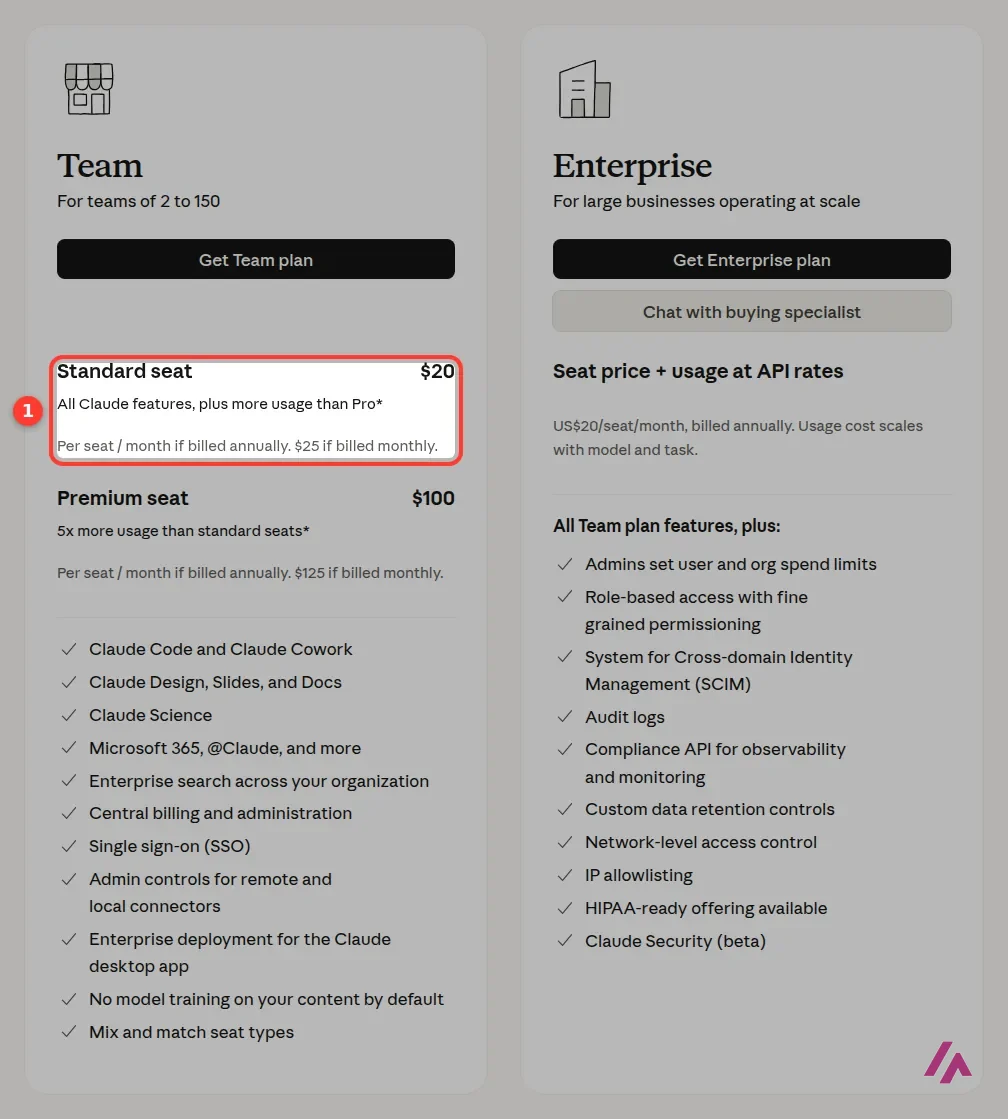
Team is for 2 to 150 people, and you can mix standard and premium seats, which is the smart move: give premium seats to the two developers who live in Claude Code and standard seats to everyone else. You can add seats mid-term and pay monthly or annually by card. Team now also includes monthly API credits: $20 per standard seat and $100 per premium seat, pooled into one balance and capped at $500 a month.
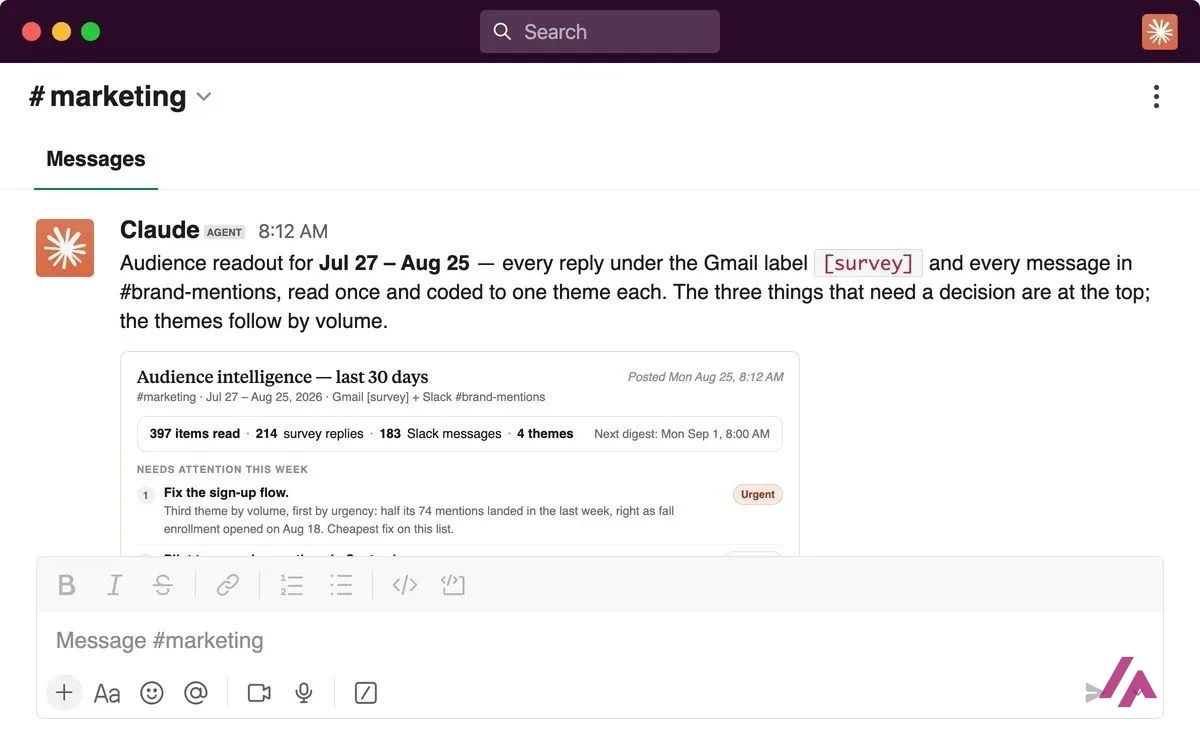
A standard Team seat costs a bit more than Pro ($25 vs. $20 monthly), and for that you get more usage than Pro, shared billing, admin controls, SSO and no training on your content by default. For a two-person business that handles client data, I'd take Team over two separate Pro accounts just for that last point.
Enterprise works differently: a low seat price ($20 a month, annual only) plus whatever your people use, billed at API rates. That's great if most of your staff uses Claude lightly, and a budget surprise if a few power users go wild. There's a self-serve version and a sales-assisted one with invoicing and tiered incentives on committed spend. Universities have a separate Education plan with no public price.
Turn on spend limits first (Heads-up)
On Enterprise, the pricing page says admins can set spend limits per user and per organization. Use them from day one, before a few heavy users turn the usage line into the biggest number on the invoice.
Claude API pricing per million tokens
The API is for building Claude into your own app, script or automation. You don't pay a monthly fee; you pay for tokens, the chunks of text the model reads (input) and writes (output). Sorry for the jargon; there's no simpler way to say it.
| Model | Input | Output | What Anthropic positions it for |
|---|---|---|---|
| Fable 5.1 | $10 | $50 | Long-running agents |
| Opus 5.5 | $4 | $20 | Agentic coding and enterprise work |
| Sonnet 5.5 | $2 | $10 | Coding and agents at high performance |
| Haiku 5.5 | $0.10 (prompts over 100K tokens: $0.50) | $0.50 (prompts over 100K tokens: $2.50) | High-volume, cost-sensitive tasks; Anthropic's fastest model at standard speed |
Standard tier. Haiku 5.5 is the only model with two prices, depending on whether the prompt is up to or over 100,000 tokens. Batch processing is 50% off. US-only inference costs 1.1x standard rates.
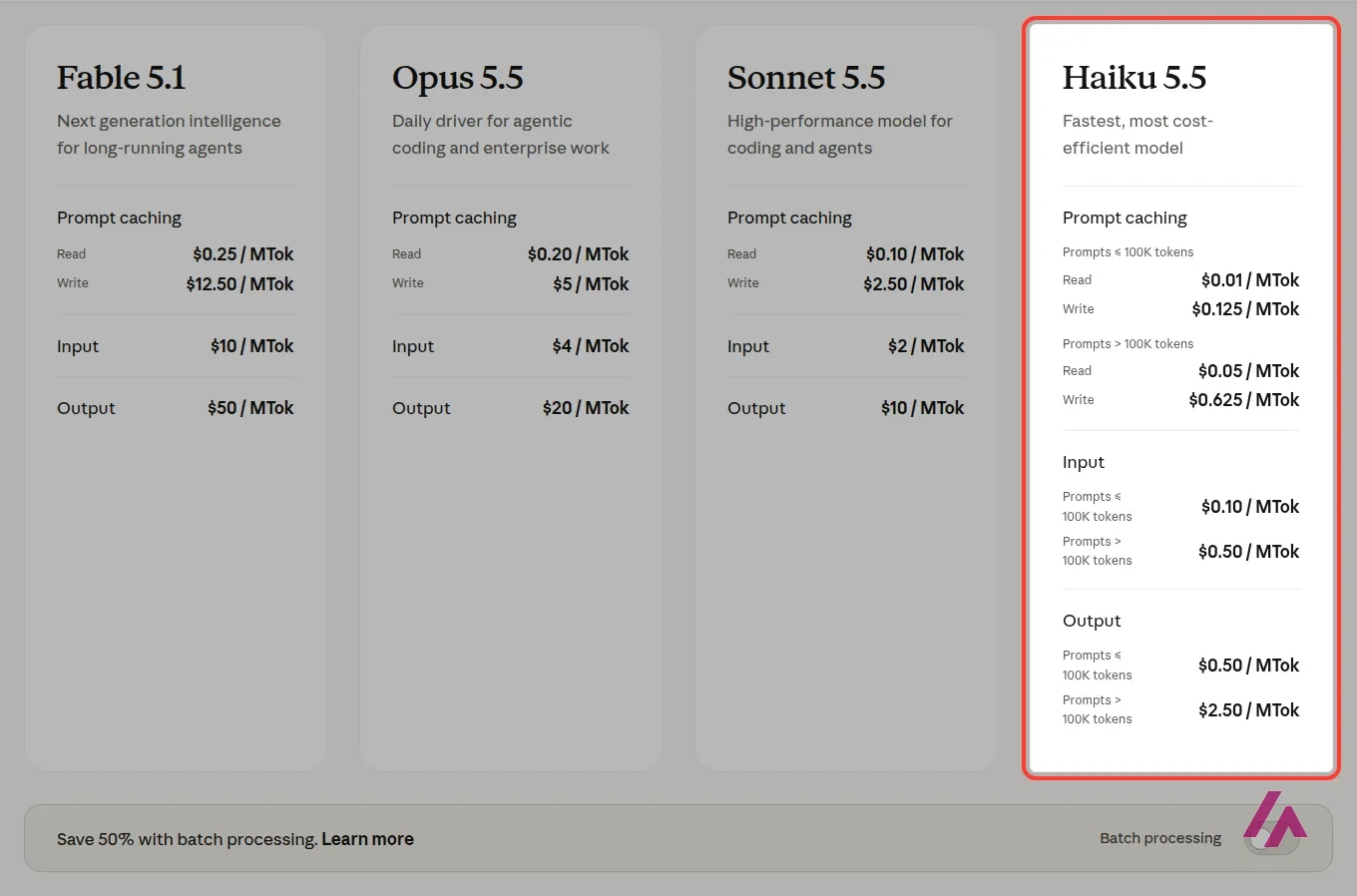
To make that concrete: say your app sends 1,000 requests, each with about 2,000 tokens of input and 500 of output, to Sonnet 5.5. That's 2 million input tokens ($4) plus half a million output tokens ($5): about $9. The same job on Haiku 5.5 comes to about $0.45, and on Opus 5.5 to about $18. Yes, that's a twentieth of the Sonnet bill, and no, you don't get Sonnet's brains for it: Anthropic pitches Haiku 5.5 for quick, repetitive work like summaries, classification and database queries, and as a helper that a bigger model hands smaller jobs to. For complex agentic coding, Anthropic itself still points you to Sonnet 5.5 or Opus 5.5.
A few extras on the same page that change the bill:
- Batch processing cuts prices by 50% if you can wait for results instead of getting them live.
- Prompt caching makes repeated context (a long system prompt, the same document) much cheaper to reread. Anthropic has just halved Sonnet 5.5's cache reads to $0.10 per million tokens, which it says makes Sonnet 5.5 around 20% cheaper on most agentic work.
- Fast mode for Opus 5.5: Anthropic says it's up to 2.5x faster, at 2x the standard price.
- Web search through the API costs $10 per 1,000 searches, on top of tokens.
- Older models are still listed: Sonnet 5 keeps the same $2 / $10 as Sonnet 5.5, older Opus models cost $5 / $25 and Sonnet 4.6 and 4.5 cost $3 / $15, so Opus 5.5 is actually cheaper than its predecessors and there's little reason to stay on the old ones for price. Haiku 4.5 has joined that legacy list at $1 / $5, ten times Haiku 5.5's per-token price on short prompts.
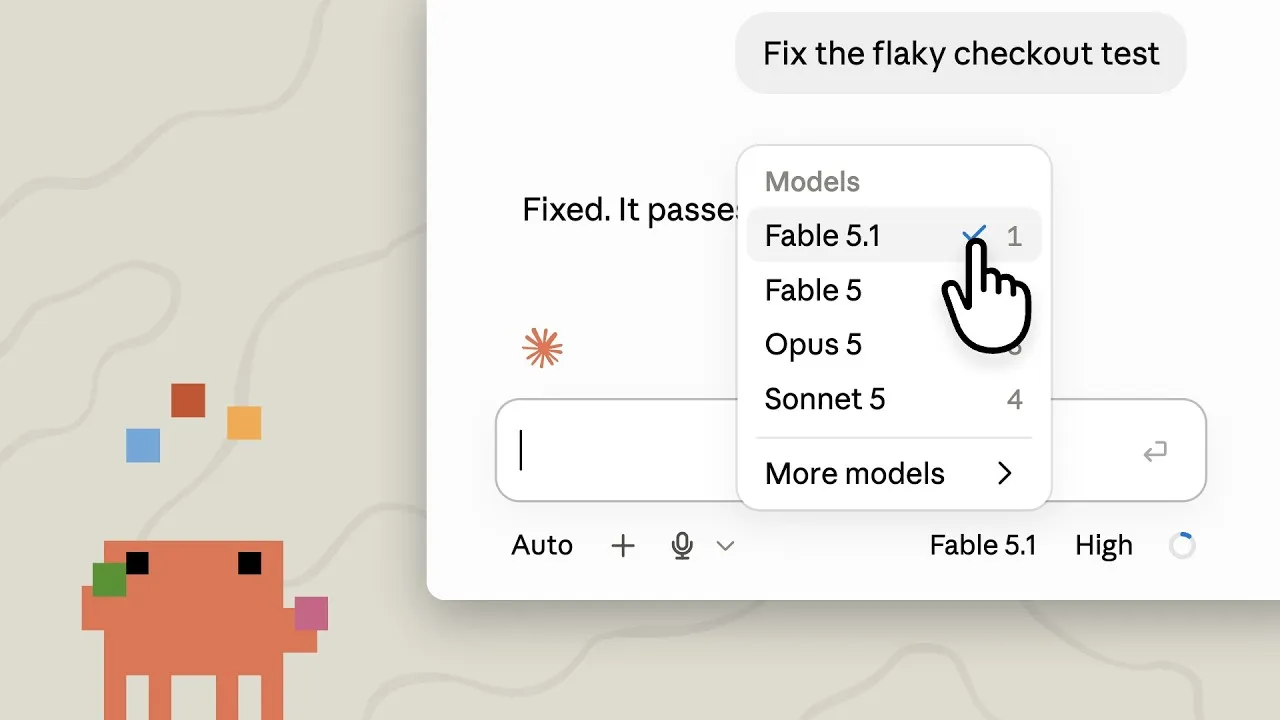
Anthropic's short video on what decides the cost of a task: its case is that picking the cheapest model at the lowest effort isn't always the cheaper choice, and that a more capable model like Fable 5.1 can cost less to complete a task, plus which model and effort to pick for open-ended and for routine work. It's the maker talking about its own models, so check it against your own bill.
API or subscription: which one do you need?
If a human is typing (you, chatting or coding with Claude Code), get a subscription. It's a flat, predictable price instead of a per-token bill that grows with every long session.
If software is calling Claude (a customer support bot, a script that processes 5,000 documents a night, a feature inside your product), you need the API: what a plan gives you in the apps and Claude Code doesn't cover that. You can have both: Pro or Max for yourself and a Console account for your app. On Max or Team, the monthly API credit means a small side project can run on the plan's credit first.
An independent walk-through of Pro, Max and the API from someone who says he runs two Max plans, with a warning about running tools like OpenClaw on a Pro or Max account instead of the API. It's from February 2026, so check today's prices and models against the ones in the video.
How to pay less for Claude
- Start on Free and only upgrade when the five-hour limit gets in your way.
- Pay Pro annually once you're sure: $200 instead of $240.
- Check the web price first. Anthropic's Help Center says its Max prices are for web subscriptions and mobile pricing may vary by app store.
- Save Opus for the hard problems. Anthropic says the model you pick affects how fast you use your allowance.
- Don't wait for a permanent discount. Anthropic says it has no standing discounts on Pro or Max, only occasional limited-time promotions.
- On the API, batch and cache. Half price on anything that can wait is an easy saving.
- Try Haiku 5.5 first for high-volume, simple jobs. Summaries, classification and database queries are what Anthropic designed it for, and on short prompts its per-token price is a tenth of Haiku 4.5's.
- For teams, mix seats instead of buying premium for everyone.
The plan I'd pick, depending on how you use it
| If you… | Pick | Why |
|---|---|---|
| Ask a few questions a week, draft emails, summarize PDFs | Free | Sonnet, web search, files and memory are all there. Paying buys limits you won't reach |
| Use Claude daily for work or study | Pro, annual | Opus, Claude Code and Research for $17 a month |
| Hit Pro's limit several times a week, or code with Claude Code for hours | Max 5x | Same per-session rate as monthly Pro, without the interruptions |
| Run Claude Code or long agent tasks all day | Max 20x | Lowest per-session cost of any paid individual plan |
| Are a small company handling client data | Team | Shared billing, SSO and no training on your content by default |
| Are building an app or automation | API | You pay per token; Max and Team now include a monthly API credit to start with |
If you're weighing Claude against ChatGPT, don't decide on the price tag alone: try both free plans for a week and pay for the one you keep opening. If you code in the terminal, having Claude Code included in Pro is a strong argument for Claude's $20.
Prices and plans are subject to change at Anthropic's discretion, so if something here no longer matches the pricing page, trust the page and tell me through the contact form so I can update this.
In IT since 2002: systems, engineering, web development and SEO. I have been doing business with AI since February 2023, when ChatGPT could first be bought in Spain.
Related guides
-

Tools
Higgsfield MCP: How to Connect It and What It Costs
Higgsfield MCP lets Claude or ChatGPT make images and videos with your Higgsfield account. It takes a paid plan and always spends credits, even if…
-
Tools
Claude Fable 5.1: What It Is, Who Can Use It and What It Costs
Fable 5.1 is the most capable Claude model you can use today, and also the slowest and most expensive. Here's which plans get it, what it costs on the…
-
Business applications
MCP: the magic bridge that connects AI with the real world
Can you imagine if your favorite chatbot could read your Google Drive files, send messages via Slack, or even modify documents on your computer…


Anything left unclear? Ask me
I’m Miguel Ángel, and I’ll answer you myself, right here. And if something is out of date, tell me and I’ll fix it.